
For service providers

Webinar: Restraining orders and managing post-separation abuse

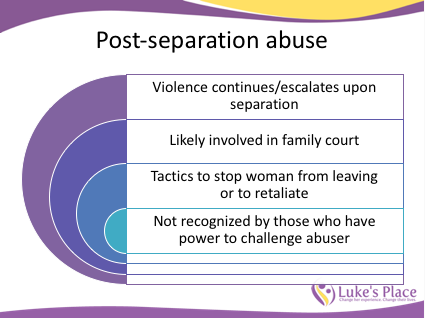
Family violence continues and often escalates post-separation. This webinar explores post-separation abuse and strategies for managing it, including restraining orders and safety planning.
What is a restraining order? How would someone get one? This webinar answers those questions and more.
This webinar is the latest in a series on family law issues when there’s family violence presented by Luke’s Place in partnership with CLEO,

Read more

Why do so few Indigenous women engage with the family law system?

At the 2019 Annual Gathering of Family Court Support Workers, Indigenous lawyers and leaders, Jeffery Hewitt and Bev Jacobs, discussed “Reconciliation and Indigenous Voices in our Work”. During this session, Jeffery made the point that FCSWs likely don’t see a lot of Indigenous women in the course of their work.

The Truth and Reconciliation Commission’s Recommendations and Violence Against Women

I. Introduction
This paper offers a brief discussion of the implications of the Truth and Reconciliation Commission’s recommendations on violence against women, with an emphasis on family law services and law reform. I begin with a review of the background on the Truth and Reconciliation Commission; the report and recommendations. I then discuss the unique circumstances and challenges Indigenous women face with respect to violence against women,

Women in rural, remote communities get long distance legal help

Family law lawyers are thin on the ground in many rural and remote parts of Ontario. Family law lawyers who take legal aid certificates and who have expertise in cases involving family violence are even more rare.
Women who are fleeing an abusive relationship face many challenges and stresses in their journey.

Differences between religious/cultural family laws and Canadian civil family law

There are significant differences between some cultural or religious family law and the civil family laws in Canada. It is important for women to know about these differences before they make any decisions about how they want to organize their intimate relationships or how they want to resolve the issues that arise when those relationships end.

Collecting evidence of woman abuse for family law cases: Our latest webinar

Evidence about family violence can be challenging to find: often, there are few witnesses, and many women don’t report the abuse to anyone. This webinar provides practical suggestions for how women can collect evidence of the abuse to which they have been subjected as well as tips for frontline workers who are assisting women with this task.

The journey towards inclusivity: It’s about people – 3/3

One of the most difficult things about working to make an organization inclusive is that every person has to be willing to get uncomfortable.
We all learn things about ourselves when doing this work; sometimes things that make us squirm as we come to realize how much we have taken our privilege for granted and the assumptions we have made about others.

The journey towards inclusivity: Organizational structures – Part 2/3

All of the work we do is, or should be, framed by our agency’s policies and procedures.
Policies are the guiding principles that set direction in an organization. Procedures are the specific actions or steps that are to be followed in the organization’s day to day operation. Every policy needs to have at least one procedure or it is without much meaning.

The journey towards inclusivity: Understanding the concepts – Part 1/3

The work of inclusivity requires us to look at ourselves, even when that may make us uncomfortable. Some of what is covered in these posts may seem basic to you and other ideas may be more than what your agency can take on at this time.
The most important thing is that we are aware of the work that we all have to do.

Family law issues when families change: When to return to family court

Families change over time — kids get older and move out, parents get new jobs, remarry, have more children, lose jobs, want or need to move. Any of these changes could mean a woman or her ex-partner may need to revise an existing family court order, which could involve a return to family court.