

For service providers

What should I be aware of when I am supporting an Indigenous woman who has left her abusive partner?
An Indigenous woman leaving an abusive relationship must deal with all the issues faced by any woman leaving an abuser: ensuring safety for herself and her children, finding housing, making safe custody and access arrangements for her children, sorting out financial and property issues with her former partner and so on.

Read more

Steps in a Family Law Case: Tool from CLEO

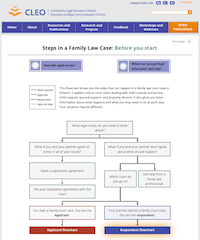
CLEO (Community Legal Education Ontario) has just released an excellent new tool, Steps in a Family Law Case, which guides you through family court processes.
This is a very helpful resource for service providers and women with family law issues. It lays out the family law case as a flowchart.

How can I support a woman who does not want to leave her abuser?

When the violence against women movement became increasingly organized in Canada and shelters for abused women and rape crisis centres began to open, most of the work was focused on helping women get away from their abusers. There was an inherent belief that this was what was best for women. While shelter work has always been rooted in a commitment to providing non-judgemental support to women,

How can I support a woman who is unrepresented in family court?

The number of litigants in family court who do not have lawyers has reached a critical point, with between 50 and 80% of cases now involving at least one party who is unrepresented. While not having a lawyer is of concern to any litigant, the impact on a woman who has left an abusive partner is significantly greater.

What is imputing income?

From time to time, the court will impute income in a child support case. This means the judge finds that the amount of income the parent who is paying support is claiming is not a fair reflection of what they could be earning and, to address this, assigns an income to the payer,

Why do the police sometimes charge an abuser even though the woman does not want them to?

Mandatory charging is a policy in place across Canada that requires police to lay charges in domestic violence cases where the officer involved believes there is a reasonable likelihood of getting a conviction, whether or not the victim wants a charge to be laid.
In order to understand the challenges this has created,

What is a “Jewish divorce”?

In Canada, marriage is ended by way of a civil divorce, pursuant to the terms of the Divorce Act, which set outs such requirements as:

At least one of the parties has to have been resident in the province where the divorce application is being made for at least one year

The parties have to have lived separate and apart for at least one year OR the party seeking the divorce must be able to establish either adultery or unconscionable cruelty by the other party

As well as terminating the marriage,

Why advocacy matters

I think sometimes when people hear the word advocacy they assume it means standing up in front of a room full of people or a street filled with demonstrators or in a government committee room to call for some kind of systemic change. Then, they assume that means they cannot do it.

10 years of life-changing legal help

From DurhamRegion.com “I feared for my life and for my children’s lives,” Ms. Murphy says, struggling to contain her tears, even though years have passed. “I was lost. I didn’t know where to turn for help.”
A friend recommended Luke’s Place.
Ms. Murphy had never heard of the local agency —

Confidentiality issues in high risk domestic violence cases

In 2011, Pamela Cross was commissioned by the Centre for Research and Education on Violence Against Women and Children at Western University to undertake research and write a report about confidentiality issues in the development and use of community collaborations to address high risk domestic violence cases.
Download Who do you want to sue you?