
Legal news & strategy

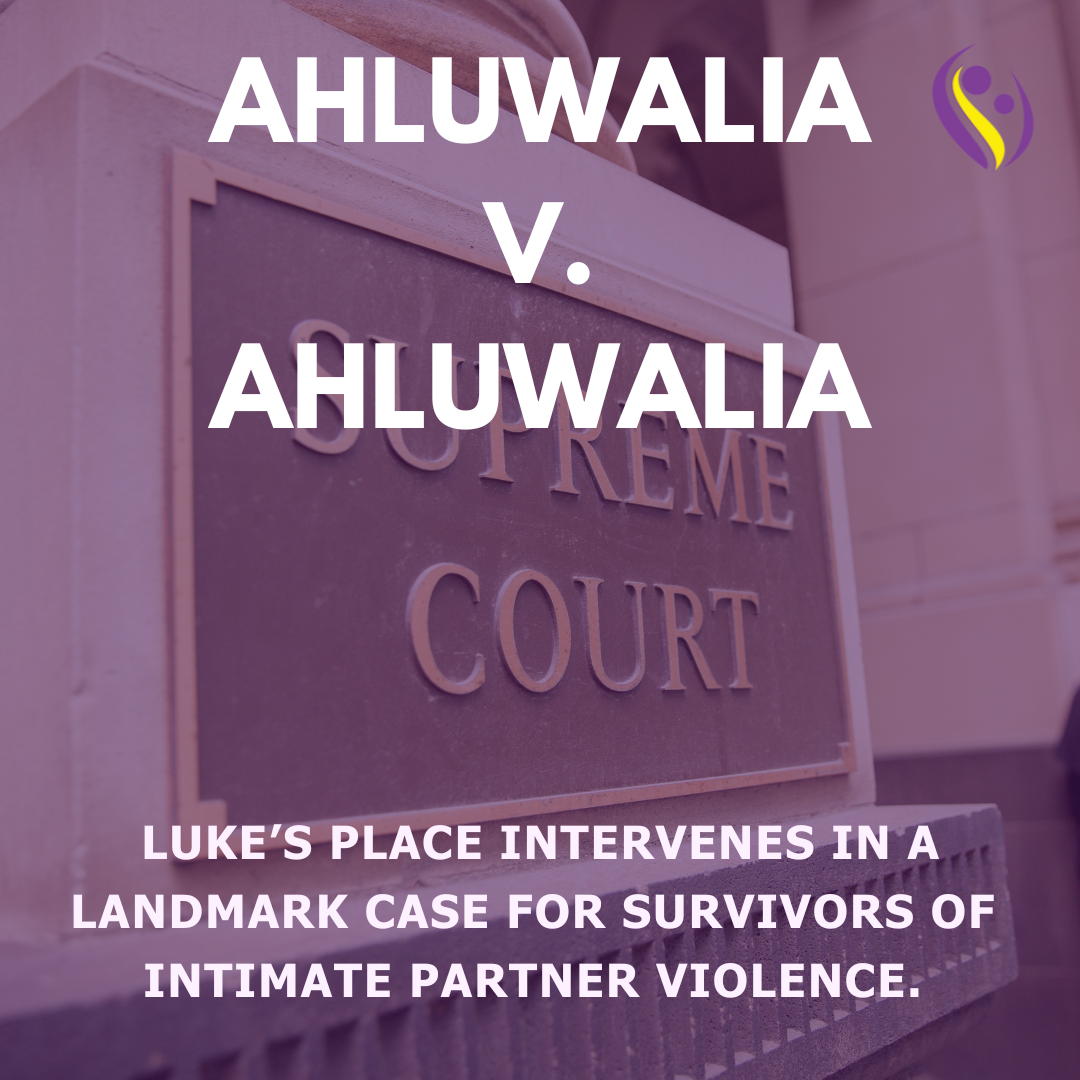
Luke’s Place will be intervening at the Supreme Court of Canada in the case of Ahluwalia v. Ahluwalia

On February 11th and 12th, 2025 Luke’s Place will appear before the Supreme Court of Canada in Ahluwalia v. Ahluwalia – a landmark case that will determine whether there should be a tort of family violence. 

This is a historic moment. Survivors of family violence often face significant legal barriers, and this case could change the landscape of legal remedies available to survivors across Canada. 

Read more

Criminalization of coercive control: shifting the focus to system change before implementation

Last week, Luke’s Place submitted a Brief to the Standing Senate Committee on Legal and Constitutional Affairs on Bill C-332, An Act to amend the Criminal Code (coercive control of intimate partner). This Brief reflects our decades of experience supporting survivors of intimate partner violence (IPV) and navigating the intersections of the family law and criminal law systems.

Mandatory Reporting is Not a Prevention Strategy

A senate public Bill, Bill S-249, has passed its first two readings and is now with the Senate Committee on Social Affairs, Science and Technology for consideration. This Bill calls for the creation of a national strategy to address intimate partner violence (IPV). Included in this Bill is a provision that proposes that this national strategy consider a mandatory reporting requirement for health practitioners to report to police when IPV is suspected.

An update on criminalizing coercive control

At Luke’s Place, we support women and their children who have left abuse and are engaged with the family law/court process through both direct service and system change work. Through this work, we have developed a deep understanding of the many ways different legal systems intersect with and affect women’s family law experiences.

Parental alienation, family violence and family law: Part two

In her 2023 report entitled, “Custody, violence against women and violence against children”, U.N. Special Rapporteur on Violence Against Women and Girls, Reem Aslalem, describes parental alienation as a “discredited and unscientific pseudo-concept” that serves as a tool for abusers  “to continue their abuse and coercion and to undermine and discredit allegations of domestic violence made by mothers who are trying to keep their children safe.”

This analysis is good news for those of us who support women and children who have fled family violence and then been subjected to false PA claims in family court.

Parental alienation, family violence and family law: Part one

The terms parental alienation syndrome (PAS) and its more recent iteration, parental alienation (PA), have been creating challenges in family law cases involving parenting claims since at least the 1990s. Initially proposed by American psychologist Richard Gardner, PAS was his response to what he claimed were false allegations of child sexual abuse brought by mothers during divorce proceedings.

Criminalizing coercive control: Part two via Law360 Canada

Over the past 40 years, we have seen the many ways in which the criminal law has failed survivors of IPV. Criminal law interventions and initiatives – new laws, changes to laws, new court processes, education for those who implement and interpret the law, different approaches to bail and to punishments for those found guilty – have failed to make significant inroads on the rates of IPV and,

Criminalizing coercive control: Part one via Law360 Canada

We’ve heard a lot about coercive control in the past few years. Its first big appearance in the legal world came with the 2021 revisions to the Divorce Act which included, among other changes, a definition of family violence that included the phrase “a pattern of coercive and controlling behaviour.”

Coercive control is a term that describes a pattern of behaviours,

Addressing the issue of parental alienation

What is parental alienation?

Parental alienation (PA) has been a challenging issue for decades for many women leaving abusive partners. In recent years, the use of PA claims has risen.

A common claim by an abusive partner is that the mother is intentionally alienating the children from him when, in fact,

How to assist a woman with a parenting plan

A parenting plan is a written document describing how your children will be raised and how parenting and decision-making will work after you and your partner separate.   

A clear and detailed parenting plan will minimize your former partner’s ability to find loopholes to exploit to exercise power and control over you and the children.